 July 2026 IssueIn this issue:  At Bolder Strategies, we work with associations at every stage — from emerging organizations finding their footing to established associations navigating complex transitions. What our team encounters, across every engagement, is a common thread: volunteer board members who are deeply committed to their respective organizations and genuinely hungry for the right guidance. At Bolder Strategies, we work with associations at every stage — from emerging organizations finding their footing to established associations navigating complex transitions. What our team encounters, across every engagement, is a common thread: volunteer board members who are deeply committed to their respective organizations and genuinely hungry for the right guidance. This newsletter is our answer to that.
The Bold Brief was created to give association leaders — whether you are a current client, a prospective partner, or simply someone who wants to lead your board well — a reliable monthly resource rooted in what our team sees working in the field every day. Our professionals work alongside boards on everything from governance structure and meeting management to financial oversight, compliance, and strategic planning. This hands-on, front-line experience informs everything we publish here.
Each issue will provide you with substantive guidance on the topics that matter most to volunteer leaders: governance best practices, financial literacy, legal and regulatory updates, and practical tools your board can use immediately. Our team has curated this issue with that purpose in mind, and we look forward to delivering The Bold Brief to your inbox every month. Association management done well is a team effort — and building strong, well-supported boards is at the center of everything we do at Bolder Strategies. We are glad to have you with us. Warmly, Dr. Nicole Singleton Norman 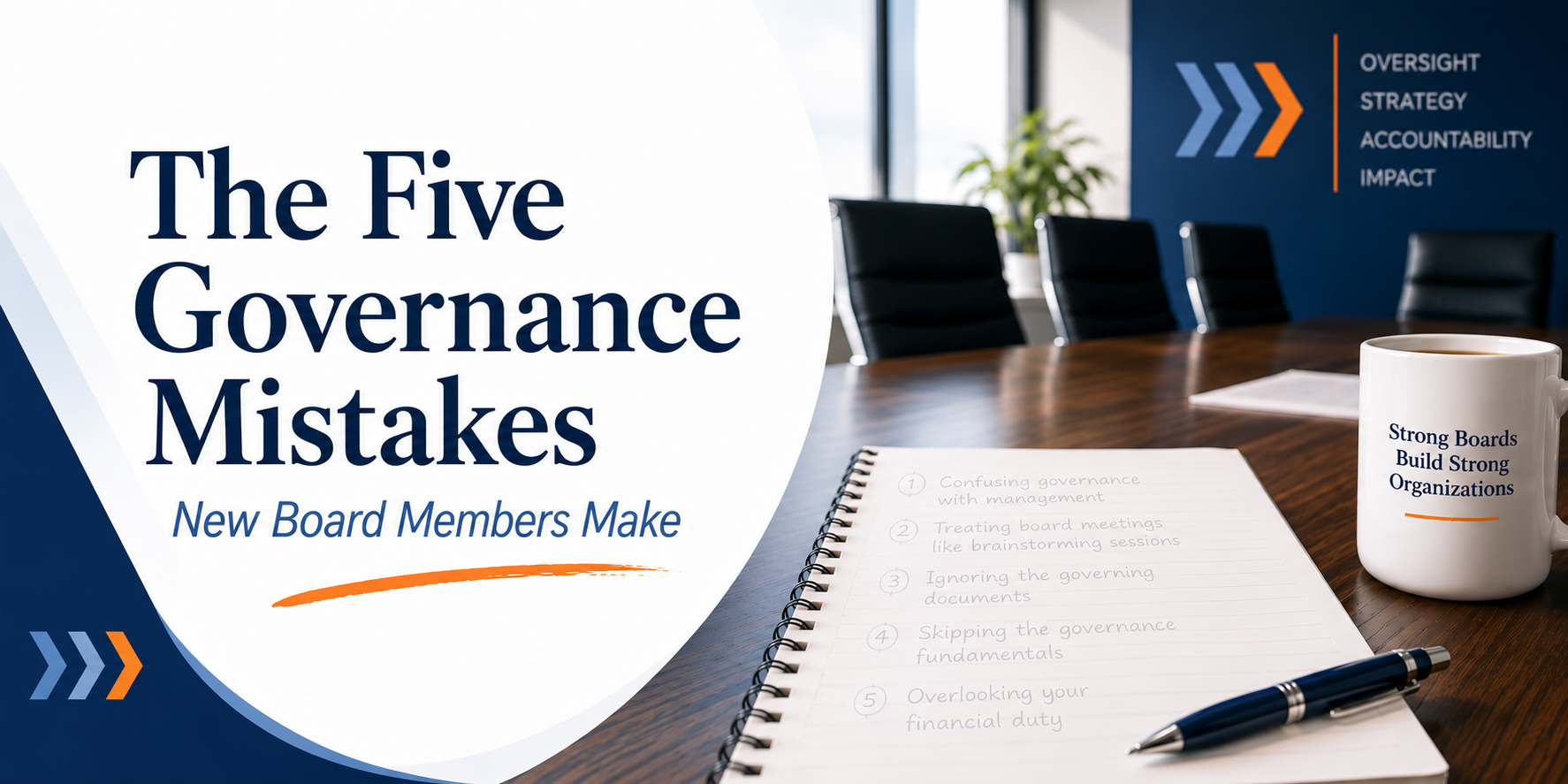 The Five Governance Mistakes New Board Members Make — and How to Avoid ThemEvery new board member starts with enthusiasm and good intentions. Most have no idea how much they do not know — and this is not criticism. Association governance is its own discipline, and very few people arrive at a board seat with formal training in it. The result? Typically, well-meaning volunteers inadvertently create problems that their associations spend months — sometimes years — sorting out. Here are the five mistakes we see most often, and our recommendations on what should be done instead: 1. Confusing Governance with Management This is the most common mistake, and it causes more internal conflict than almost anything else. Board members are responsible for board governance: setting strategic direction, establishing policy, ensuring financial health, and hiring or overseeing executive leadership. They are not responsible for management — the day-to-day operations of the association. When board members start directing staff, overriding operational decisions, or inserting themselves into routine processes, they undermine the staff or management company they have actually hired, create confusion about accountability, and often expose the organization to liability. The rule of thumb: the board speaks with one voice through formal decisions, and individual board members have no authority to act alone unless the board has specifically delegated that authority to them. 2. Treating Board Meetings Like Brainstorming Sessions Board meetings are decision-making forums, not open-ended discussions. Without proper structure, meetings run long, topics get revisited repeatedly, and members leave frustrated or stop coming altogether. Effective boards use consent agendas to handle routine approvals quickly, distribute materials in advance so meeting time is spent on deliberation rather than information-sharing, and keep a clear distinction between items that require a vote and items that are informational only. If your meetings regularly run over time or feel unproductive, the problem is almost always structure, not effort. 3. Making Decisions Outside of Meetings Text message threads. Email chains with a quick “everyone reply yes or no.” Conversations at the golf course. These are all forms of board action that — depending on your bylaws and state law — may be invalid and can absolutely create legal exposure. Formal board decisions must be made at properly convened board meetings (or via written consent procedures if your governing documents explicitly allow). Everything else is just conversation. This matters especially for decisions about contracts, finances, personnel, or any action that creates an obligation for the association. If your board regularly makes informal decisions and later ratifies them, it is time to review your meeting procedures with a professional. 4. Ignoring the Governing Documents Your association’s articles of incorporation, bylaws, and any standing rules or policies are the operating manual for your organization. Most board members have never read them. Some boards actively make decisions that contradict their own decisions. This creates a real risk. Decisions made outside the authority granted by governing documents can be challenged — by members, by regulators, or in court. More immediately, ignoring the bylaws erodes trust and creates inconsistency that breeds conflict. Every new board member should read the governing documents before their first meeting. Every board should conduct a governance review every two to three years to ensure the association’s documents still reflect how the association actually operates and what the law requires. 5. Neglecting Fiduciary Duty Board members of nonprofit associations have three core fiduciary duties: the duty of care (making informed decisions), the duty of loyalty (putting the association’s interests before their own), and the duty of obedience (acting within the organization’s stated mission and governing documents). Most board members understand the duty of loyalty in a conflict-of-interest sense — they know not to award contracts to their own company. But the duty of care is where we see the most gaps. Rubber-stamping financial reports without reviewing them, approving budgets without understanding them, or failing to ask questions because you do not want to seem uninformed — these are all failures of fiduciary duty, even when unintentional. Being an informed board member is not about having all the answers. It is about asking the right questions and ensuring you have the information you need to make sound decisions.
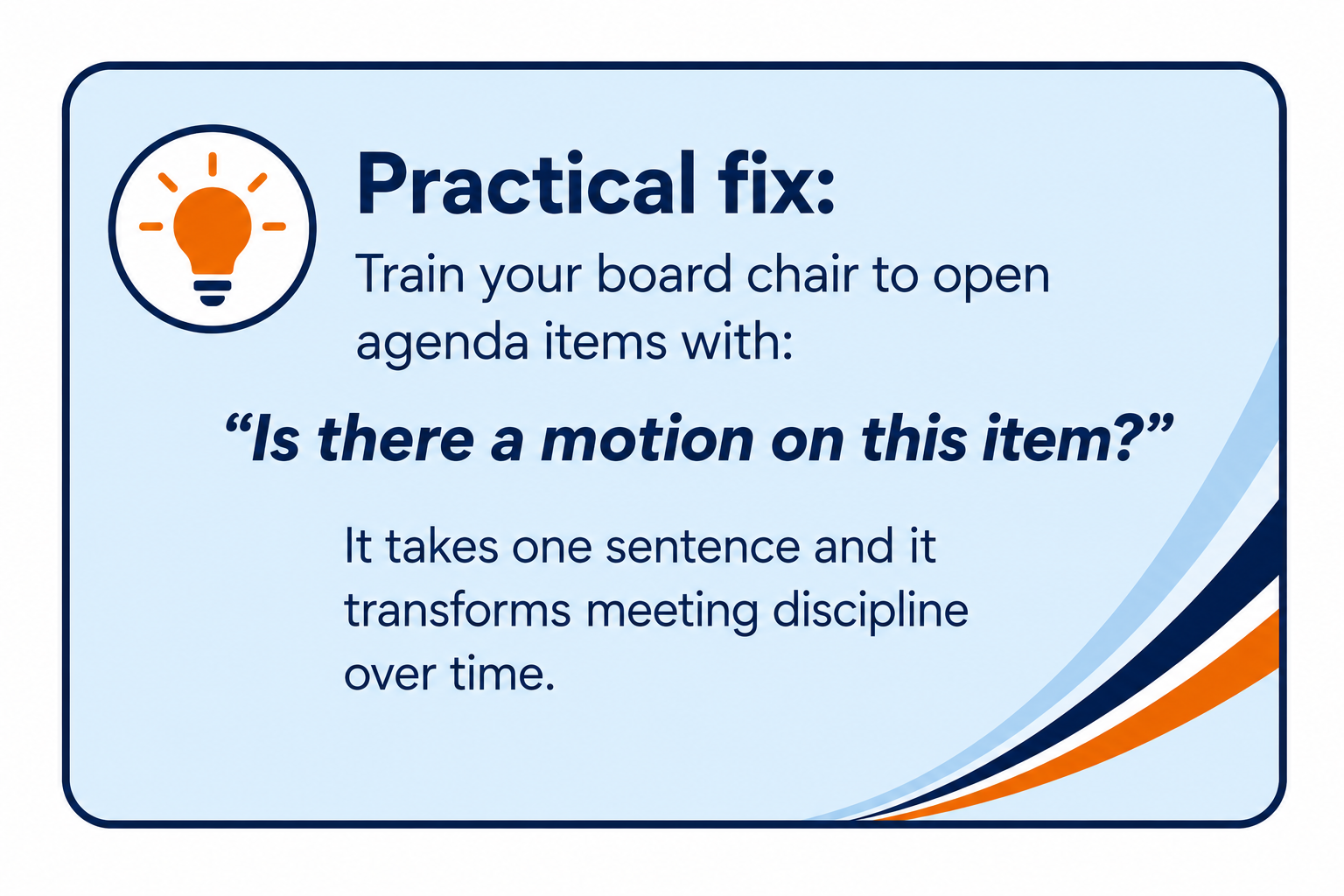
This Month’s Tip: The Difference Between a Motion and a DiscussionOne of the most common procedural mix-ups in board meetings is beginning a lengthy discussion before anyone has made a motion. Under Robert’s Rules of Order, formal deliberation on a matter should follow the introduction of a motion — not precede it. The correct sequence is simple:
When boards skip step one and dive straight into discussion, conversations tend to wander, decisions do not get formally recorded, and it is often unclear at the end of the discussion whether any action was actually taken.
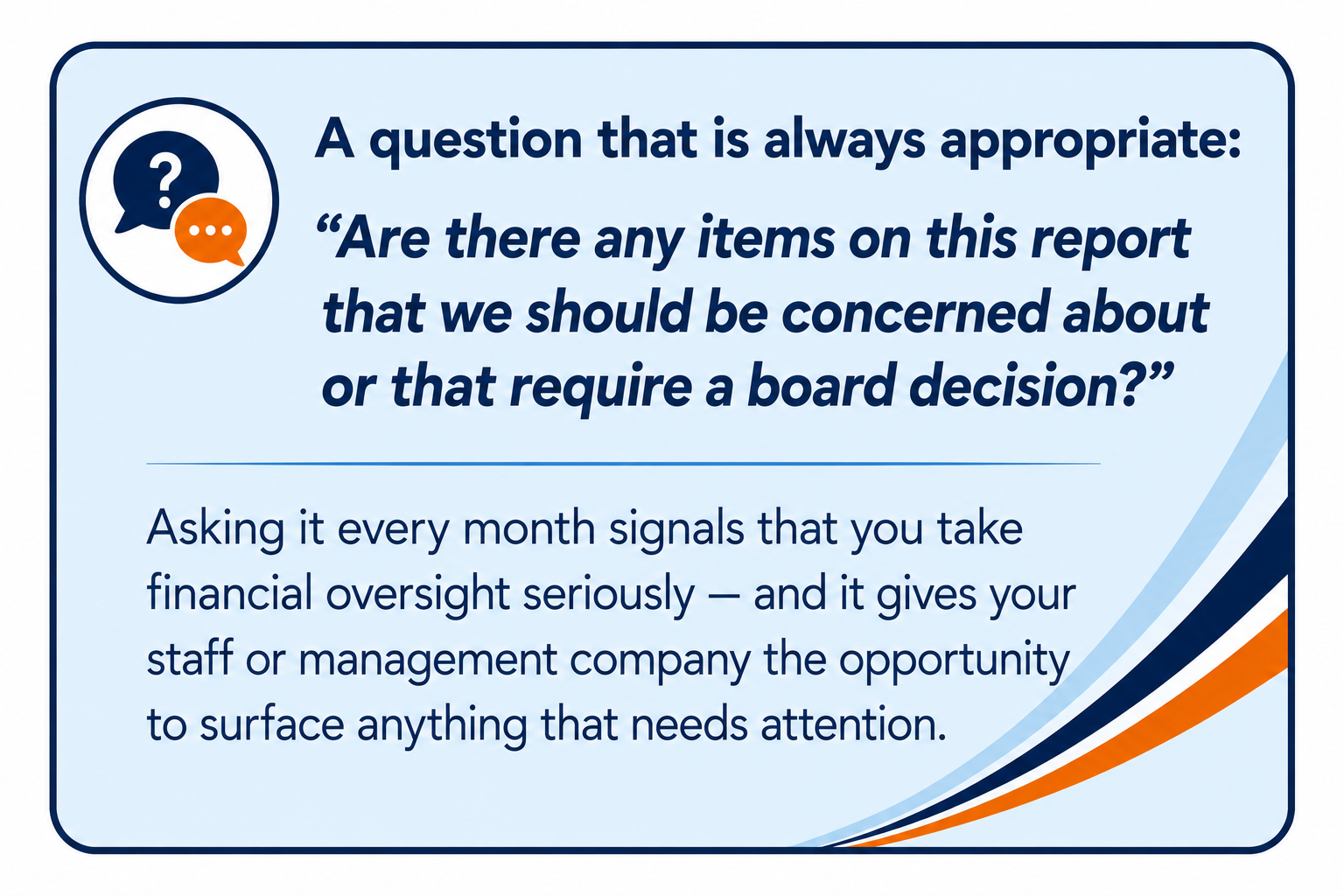
Reading Your Financial Statements: What Every Board Member Should ReviewIf you receive a financial report at each board meeting and quietly hope no one asks you about it, you are not alone. Financial statements can feel opaque — but board members have a fiduciary obligation to understand them. Here’s a starting framework. The Income Statement (Profit & Loss) The Balance Sheet The Budget-to-Actual Report
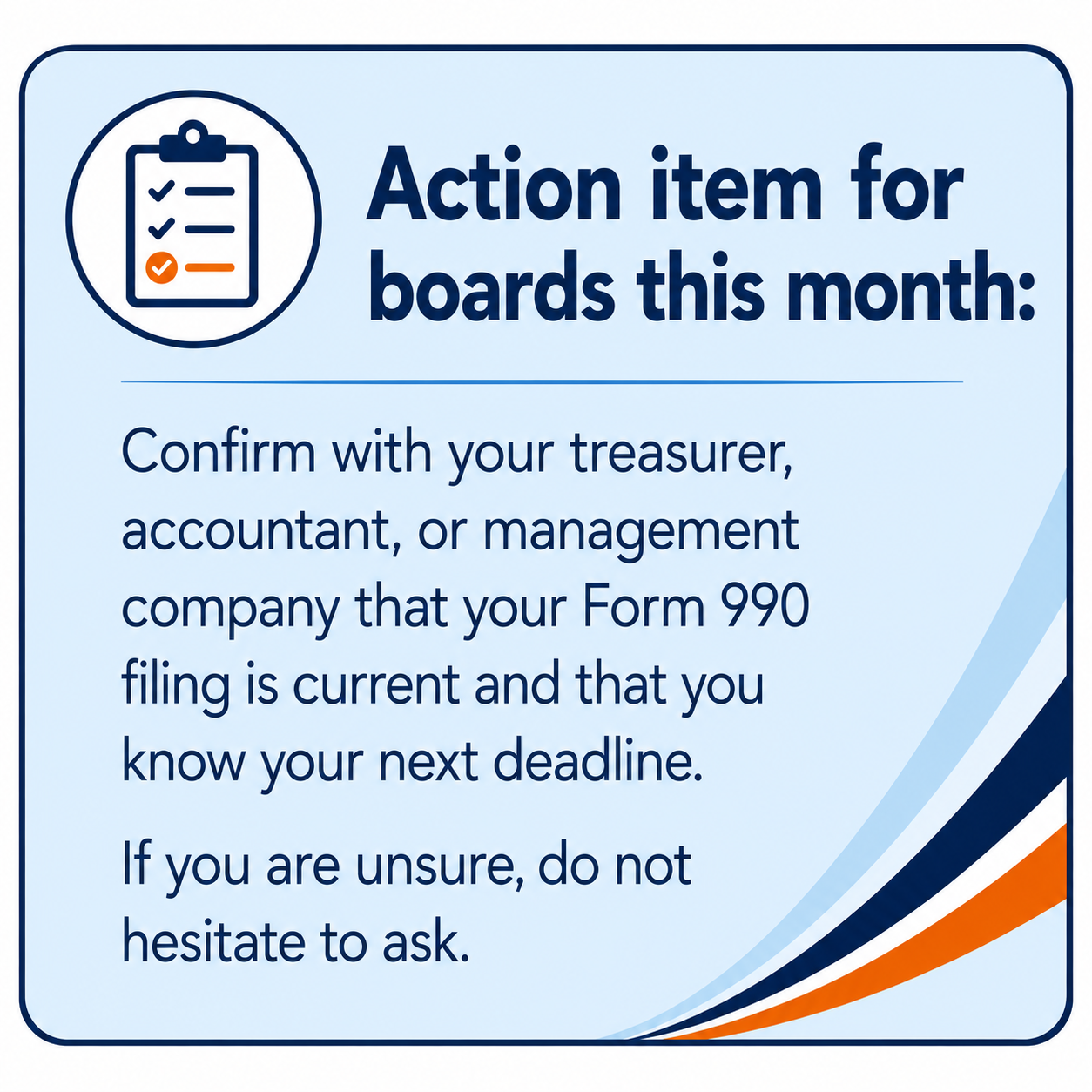
COMPLIANCE WATCH If your association is organized as a tax-exempt nonprofit, you are required to file a Form 990 with the IRS each year. The specific form (990, 990-EZ, or 990-N) depends on your annual gross receipts, but the filing obligation applies to nearly all tax-exempt organizations — including those with no paid staff. The deadline is the 15th day of the fifth month after your fiscal year ends. For associations with a December 31 fiscal year-end, that means May 15. A six-month extension is available, but it must be requested before the original deadline. Failure to file for three consecutive years results in automatic revocation of tax-exempt status — a significant consequence that is both costly and time-consuming to remedy. This column provides general information only and does not constitute legal or tax advice. Consult a qualified professional for guidance specific to your organization.
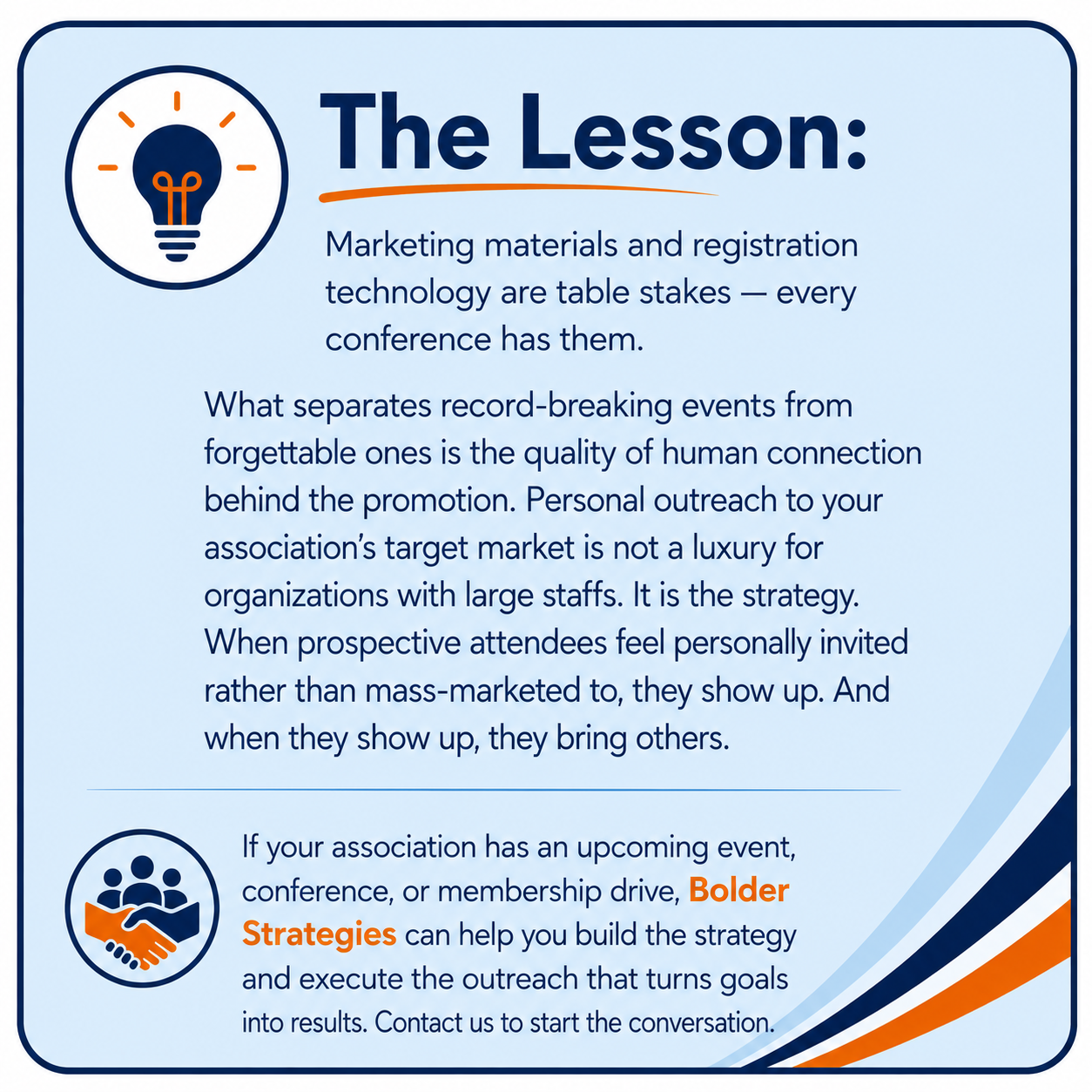
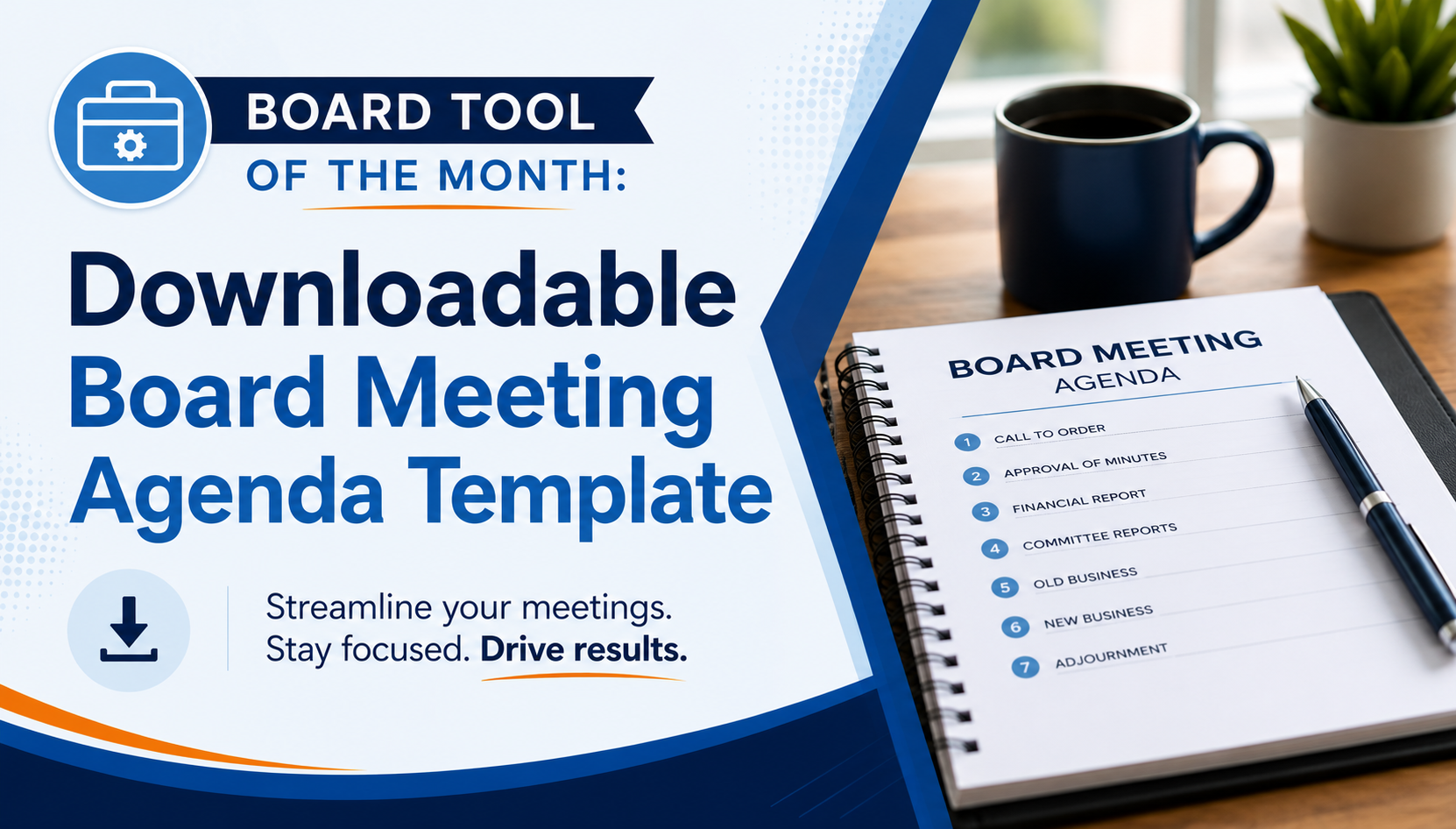
Record Attendance in Five Months: The Case for Personal OutreachA regional association engaged Bolder Strategies just five months before their annual conference with no marketing in place, registration not yet open, and a leadership transition still underway. The timeline was tight. The stakes were high. Our team moved quickly — building all marketing materials from scratch, launching online registration, and coordinating full conference logistics. Alongside the event work, we implemented a comprehensive association management strategy to stabilize the organization through the transition. What Made the Difference Rather than relying on broadcast emails alone, our team identified where prospective attendees lived professionally — their peer networks, industry channels, and affiliated communities — and made direct, individualized contact. The message wasn’t a generic invitation. Our message was very targeted: “here is why this conference is worth your time, and here is why we want you there.” That distinction — between mass communication and personal outreach — is where most associations leave attendance on the table. We made phone calls. We sent out personal text messages. We reached out directly to past members and attendees. The Result BOARD TOOL OF THE MONTH Q: One of our board members constantly goes off-agenda and monopolizes discussion. How do we handle this without creating conflict? A: This is one of the questions we hear most often, and it is almost always asked in a hushed voice — because the board member in question is often well-intentioned, and no one wants to be seen as shutting down participation. We recommend this reframe: managing discussion is not shutting someone down. Instead, it is the chair/president doing their job. A few techniques that work well in practice: Lean on the agenda. Use a “parking lot.” Set time limits explicitly. Address the pattern privately. Have a question you’d like us to address in a future issue? Send us an email to bold_brief@bolder-strategies — our team reads every response. What’s Changing in Association ManagementFour things forward-thinking boards are paying attention to right now:
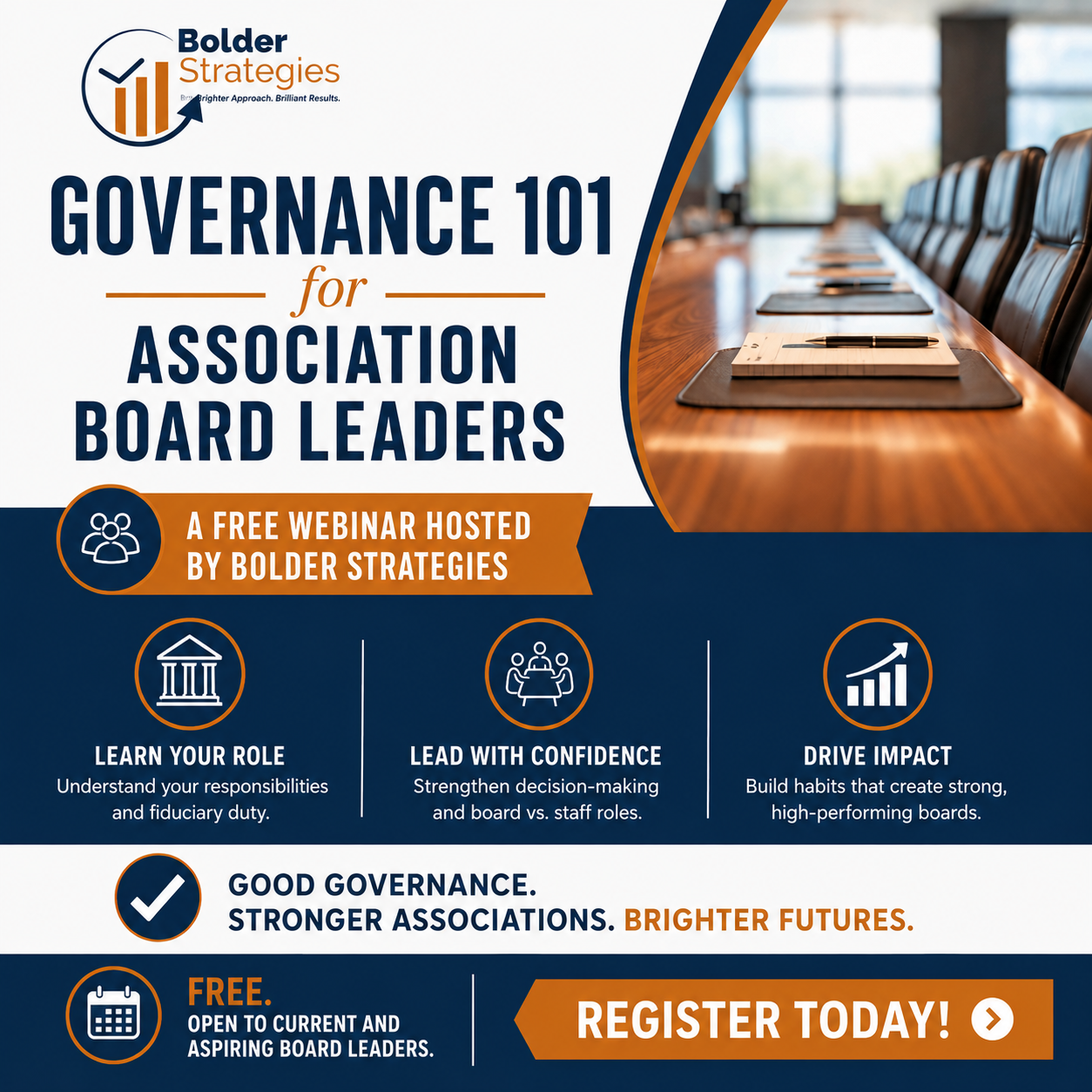
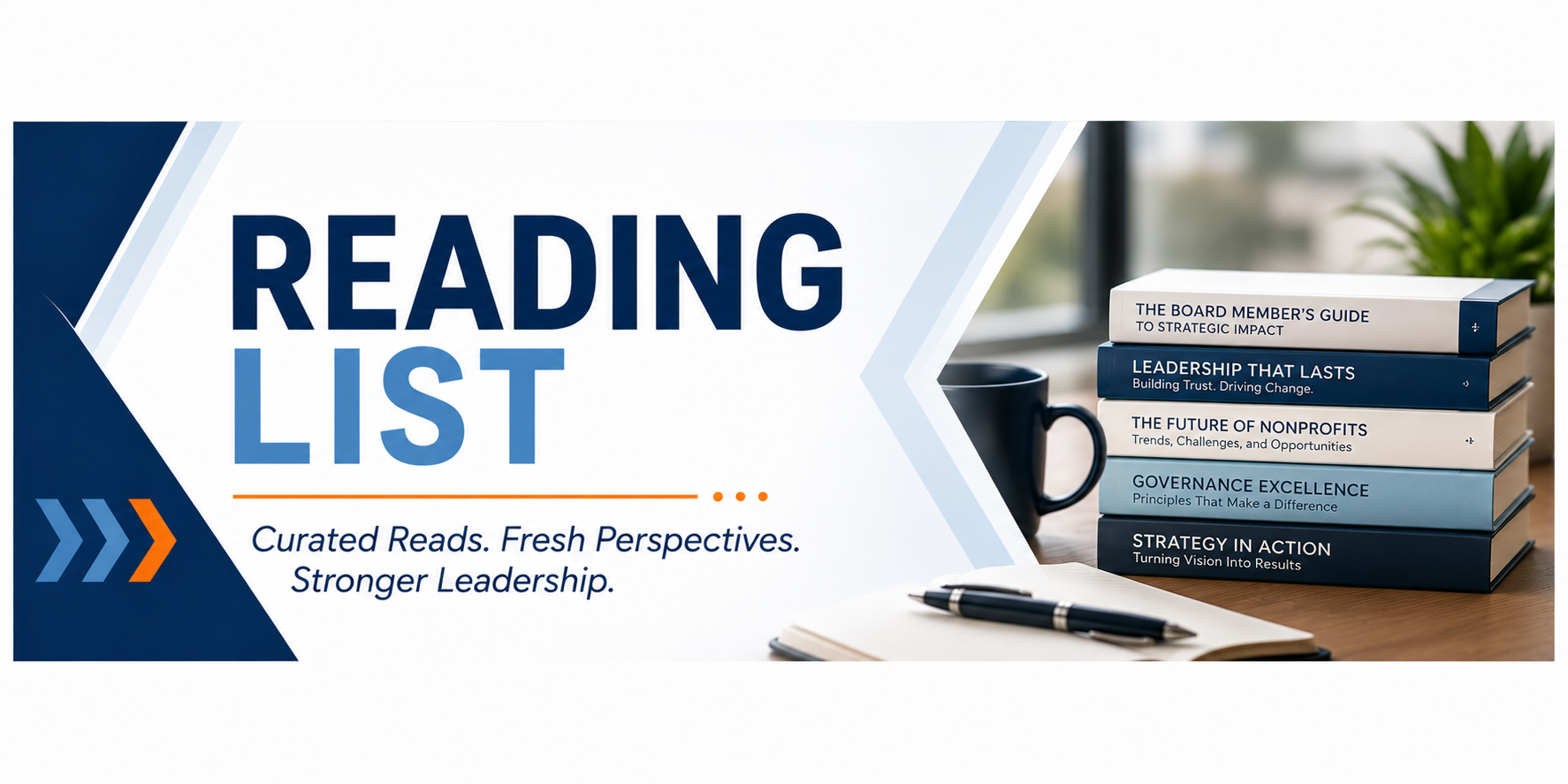
UPCOMING EVENTS Hosted by Bolder Strategies · Thursday, July 30, 2026 | 2:00pm ET A 60-minute overview of how to run effective board meetings, understand your fiduciary duties, and avoid the most common governance mistakes. Ideal for new board members or associations welcoming new leadership. READING LIST Recommended Podcast If something in this issue prompted a question, surfaced a concern, or made you think “we should probably look at that,” we would love to hear from you. Bolder Strategies works with associations of all sizes to provide professional management, governance support, and strategic guidance — so that volunteer boards can lead with confidence and actually enjoy the work they volunteered to do.
|